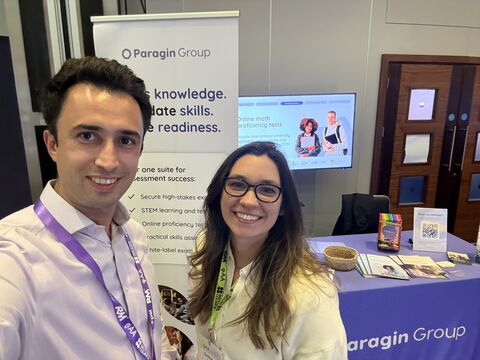
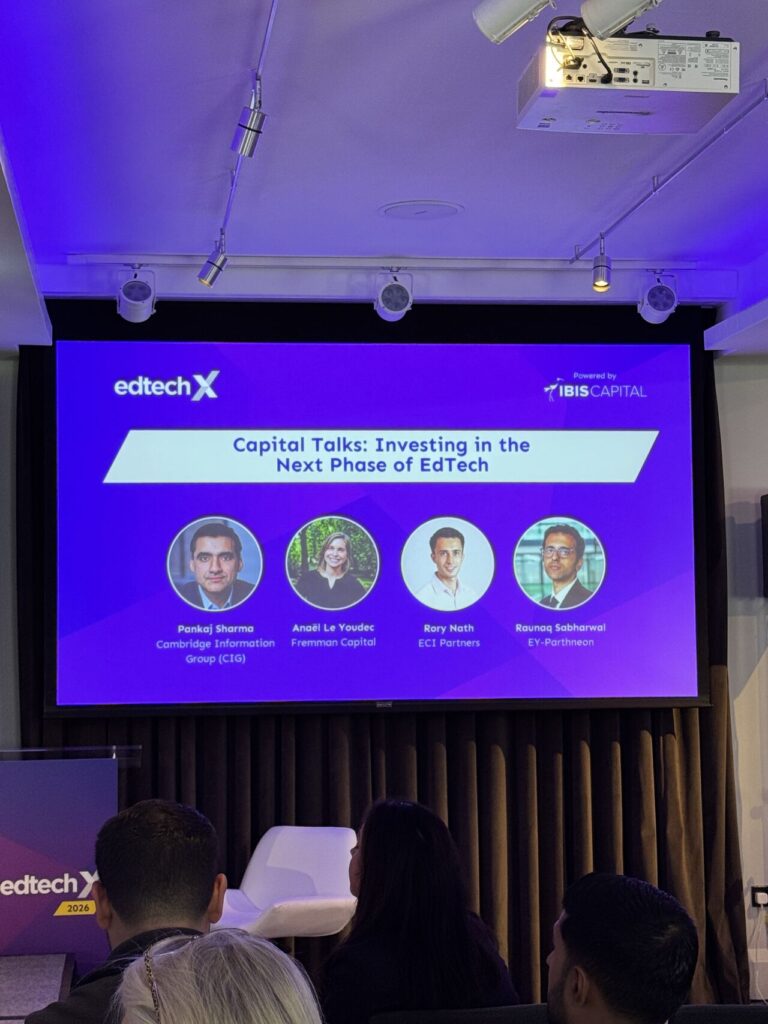
“Guilty until proven human.” That was the title of a session at this year’s e-Assessment Association conference in London, and it captured the anxiety being felt in the testing and exam industry. AI is not only being built into authoring, marking and proctoring, the same tech is now in every candidate’s pocket, threatening exam integrity. A week later I was sitting on a panel at EdTechX, where investors were circling the same problem from the other side: with AI changing everything, which of these businesses is backable?

Following our recent investment in Paragin Group, the Benelux market leader in high-stakes exams and assessment software, my two conferences in a fortnight among their peers, buyers and regulators sharpened my conviction about where the value in the market will sit.
1. Innovation needs depth
At the conferences, every vendor is demoing the same features: AI that drafts questions, AI that grades them, and AI that flags suspicious behaviour. Most of it is a thin layer over the same large language models that anyone can license. If your product is just veneer on a model your competitor can call tomorrow, that’s not sustainable differentiation.
The businesses that stood out did the opposite to this. One UK-based provider, Risr, had trained its AI on deep, privileged medical training content in partnership with RCGP. Together, they developed an AI patient with an optional AI coach to help trainee GPs through simulated patient consultations to prepare for their final practical exams, something a general-purpose model cannot replicate without the underlying case bank. On my panel, this was the overarching theme – AI is an advantage where it sits on vertical depth, e.g. proprietary content or genuine domain expertise, where you know your customers’ workflows better than your competition. That last 10% of depth in customer knowledge is what impressed us most about the Paragin team. It leads to genuine innovation that can’t just be reskinned. Paragin has built out the most complete solution set on the market; AI can help us deliver on our roadmap more quickly, but it is human expertise that gives the edge on its direction.
2. Integrity has to be the sell
Strip away the technology, and what an awarding body actually sells is confidence that a grade means what it says. England’s exams regulator, Ofqual, was unambiguous at the conference: its priority is trust in qualifications, technology comes second, and there are no guinea pigs when 800,000 students sit a GCSE on the same morning.
That is why the market will be conservative on AI adoption, and why owning the narrative on security and fairness is more important than features. This is also why outsiders underestimate the ease of disruption. You are selling to cautious buyers to whom brand trust is everything; it’s much more than just the hassle of changing systems. It’s much easier for an AI-native challenger to copy a feature than it is to displace loyalty, and that caution by buyers protects market incumbents who have an earned reputation.
3. Security and fairness are designed in
High-stakes testing is, at its core, a business built on trust with people’s most sensitive data. A set of results can decide whether someone qualifies as a doctor, an accountant or an engineer, so security, data protection and fairness have to be designed into the technology from the outset. Regulation is now formalising this, and under the EU AI Act, AI used to evaluate learning or to monitor candidates during a test is explicitly classed as high-risk, which carries real obligations around documentation, human oversight and demonstrable fairness. The recent move of that deadline from August 2026 to 2 December 2027 under the Digital Omnibus package changes the timing, not the direction of travel, and similar expectations are forming well beyond the EU’s borders.
For an investor, this is where track record and scale count. Building security and fairness into an assessment platform and being able to prove it is the work of years. Paragin has spent over twenty years wrestling with exactly these questions while continuing to innovate, and it has the scale to treat compliance and security as core to the product rather than a tax on growth. That hard-won experience, plus the resource capability to meet increased regulations, is difficult for a challenger to replicate.
For Paragin, this creates M&A and growth opportunities – as the bar on security and compliance keeps rising, many capable but sub-scale assessment businesses will struggle to clear it alone, and a platform that already takes these things seriously becomes the natural home for them to join. We can be a trusted and mission-aligned custodian of acquired businesses, with the scale to invest in leading edge group roles, like our newly appointed Cyber Security Engineer.
The sharpest test I heard in two weeks was the one put to our panel: can a business explain why it will still need to exist once AI is everywhere? In e-assessment, the answer, in my view, is that the winners over the next three to five years will be the ones that treat integrity and compliance as the point of the exercise rather than the price of it, because that is exactly what AI cannot commoditise.