
ECI was founded in 1976, at the very beginning of what would become the mid-market private equity industry in the UK. We feel incredibly proud of what the team has achieved over those 50 years: we are one of the longest-standing private equity firms in the UK; we’ve backed hundreds of management teams, delivering transformative transactions and exceptional returns for our investors. Here we draw on five decades of private equity history to highlight some of the changes both in the industry and our business, and our excitement about what comes next.
50 years ago this month
22 June 1976 – the first day of a long hot summer in which temperatures exceeded 32.2ºC for a record-breaking 15-day stretch. The average house price was £12,704, the average wage £72 a week and a pint of beer cost just 32p. It was the day ECI Partners was founded, forming one of the earliest linchpins of private equity in the UK.


In 1976 the UK private equity market was fragmented and institution led. There were fewer than 10 dedicated PE firms, which back then were divisions of merchant banks, government-backed institutions and investment arms, rather than the independent PE houses that have become the norm today.

ECI Partners (then Equity Capital for Industry) was established with backing from the Bank of England as one of the first institutional private equity providers bridging post-war development finance and modern buyouts. Our first fund, ECI 1, was £40m (a long way off our latest Fund, ECI 12, at £1bn).
Ken Landsberg, a former ECI Managing Partner, sets the scene: “Two oil shocks in 1974 and 1976 hit the stock market very negatively, and the Labour government decided to regulate the market to force investment. The Bank of England disagreed and helped raise a lifeboat fund to support companies, approaching 250 institutions, insurance companies and pension funds to raise a total of £40 million. A board was created from c.15 of the great and good in the city, including Tony Lorenz, and after a few years the management team agreed a change in strategy was needed. Tony suggested venture capital following his experience of what was happening in the US. The Board backed him, and in turn he became the first Managing Partner of ECI.”
Tony Lorenz went on to be one of the three founding members of the British Venture Capital Association (now UK Private Capital), and ECI was a founding member of the EVCA, its European equivalent. Their mission was to achieve industry recognition by government and regulators, to set standards and valuation norms and to achieve credibility with institutional investors.
The professionalisation of the industry
The early 1980s saw explosive growth in UK PE, driven by Thatcher era reforms, with pension funds, foundations and endowments starting to allocate to private equity, and the industry transitioning from niche to mainstream with investors like MIT and Greater Manchester Pension Fund.
Landsberg comments: “In the ‘80s we were investing across the board – startups, development capital, so-called buyouts, mid-market buyouts, big leveraged buyouts, even pre-startups, which were just a bit of paper and someone’s idea. We got opportunities via the merchant banks, but you would also get calls from the street – everything from automatic bed making machines to flying cars. It was an enterprise economy, and there wasn’t much competition at the time from other investors.” This wider spectrum of opportunities led to the number of ECI’s deals increasing from 52 for the five-year period from 1980-1984, to 192 from 1985-1989.
How ECI’s deal mix evolved
From generalist investor to focused mid-market growth buyout house
1980s — 8 deal categories, 244 deals
Capital invested in buyouts by decade
1980s deals
244
across 8 categories
Buyout focus from
1990
Total buyout capital since inception
£3.3bn
† 2020s is a partial decade only — capital invested so far (2020–26).
By the end of the 1980s, the ECI team – who now had spreadsheets to analyse performance of deal types – was increasingly focussing on buyouts. Landsberg described it as a fundamental strategy change, “We shifted from a generalist to focussing on smaller or mid-market buyouts, and with it became much clearer on what we were looking for. Businesses with strong management, robust business models and sustainable growth markets.”
As the industry professionalised, more money flowed in, more Funds were set up, and ECI’s cheque size increased >750x from ECI 1 to ECI 12. It’s clear the PE industry now underpins the UK business environment that ECI was created to help support. But, in an industry where new names appear as often as familiar ones fade, how does a private equity firm last 50 years?
How to last 50 years in private equity?
1. Performance
Clearly you don’t get to last fifty years in this business without strong performance, and over ECI’s 50-year history, we’ve consistently outperformed the market, with five of our last seven realised funds in the top quartile for performance.
ECI vs UK private capital benchmark — DPI
Distributions to paid-in by vintage year
DPI
DPI
DPI
ECI internal data as at June 2026. UK Private Capital benchmark as at latest reporting (June 2025).
That success doesn’t just drive our longevity; it’s created by it. Having supported over 200 management buyouts since inception – against a median of 96 total deals among the top 50 UK mid-market PE firms – and now deploying our 12th fund, where peers average just 5, the chances are we’ve seen a challenge or opportunity before.
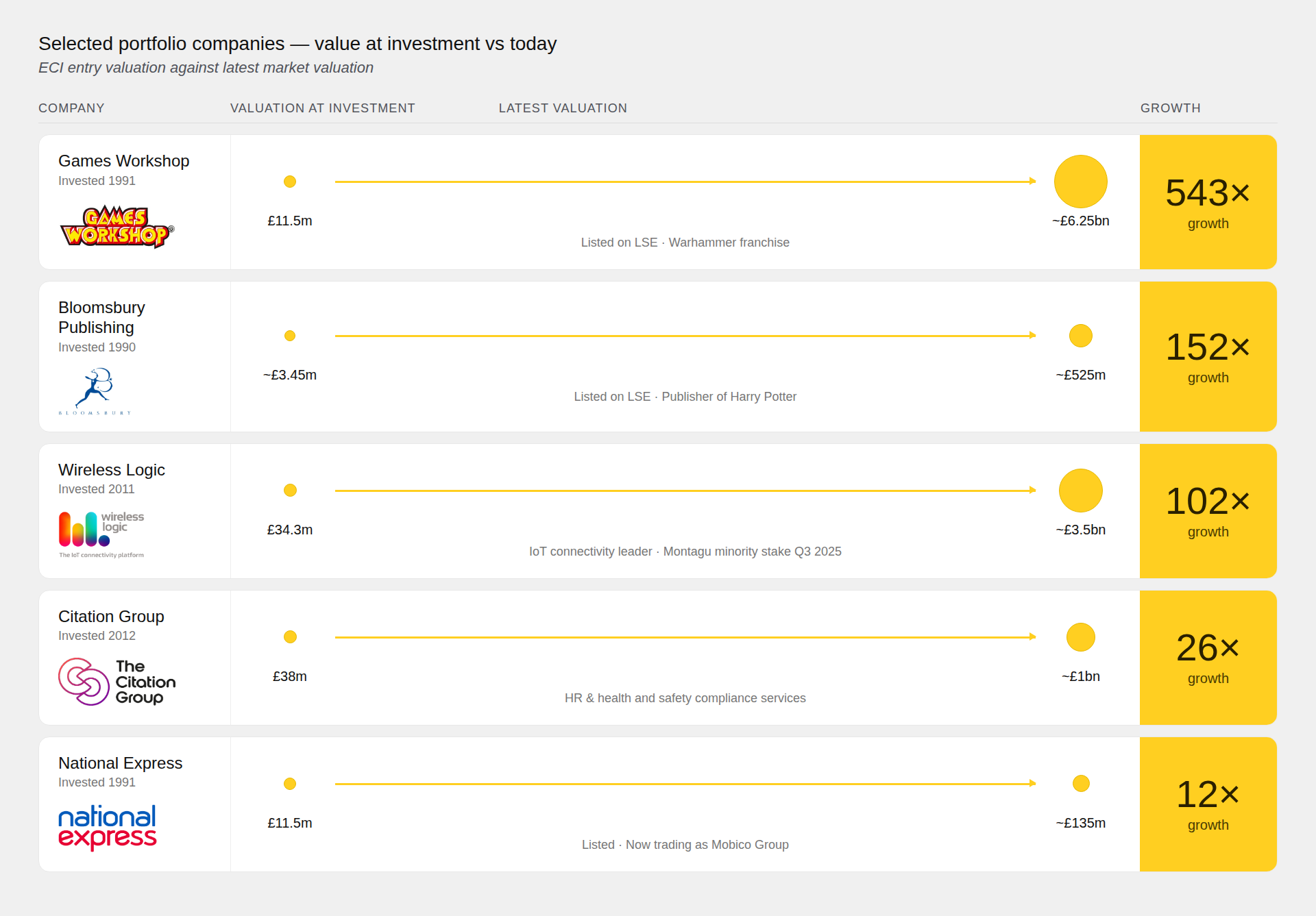
It means we’ve been lucky to work with some amazing companies across our history, and nothing makes us prouder than seeing investments go on to be success stories long after our investment. Some might wonder what would have happened if ECI’s eight-year hold of Bloomsbury Publishing hadn’t ended just two years before they acquired the rights to Harry Potter… but really, we’re just proud to have been a small part of some fantastic business’s growth journey, and their long-term success is what makes this job so fun.
2. Proven succession model
According to a study by Josh Lerner and Diane Noble, PE founder tenure is unusually long at 19 years, with the study also showing that most LPs believe founders and leaders generally stay too long. Founder succession is a key question from LPs, as for many PE firms it’s unproven.
ECI has benefited from having solved the problem early, putting in place a managed succession model in 1999. That means there are four Managing Partners, with a new one joining and another moving into a non-exec role over a cycle. That means there are constantly fresh perspectives at the table, plus a clear roadmap to a leadership role for Partners, allowing the firm to deliver steady evolution and retain its top talent.
of top 50 mid-market
PE firms are founder led
ECI Partners has had five successful leadership transitions over the last 20 years and has never experienced a team spin out in its 50-year history. In comparison, 52% of the top 50 mid-market PE firms are the product of a spin out, and 26% have had a spin out since they were founded. This is an inevitable product of GPs having a founder model where one or two Founders might stay for 15-20 years in a leadership role. ECI research shows that only 38% of the top 50 UK PE firms are non-founder led.
3. Evolution and investment
You don’t last fifty years in private equity by standing still. We continue to evolve. We were the first UK mid-market private equity firm to build out a dedicated Origination team and then a value creation team in our Commercial Team. Sean Whelan comments on the founding of the Commercial Team: “We designed the Commercial Team as we recognised that great management teams don’t always have the luxury of having time or spare people to help progress new ideas. An independent team that starts working with them during the deal, right in the commercial due diligence, straight into the strategy post-investment. It helps management teams move faster and grow quicker.”
And today we’re at a great catalyst point for investors being able to help management teams leverage the opportunities of AI and scale faster than before. Not only does our AI and Data toolkit help management teams directly, but it’s transforming how both ECI and its portfolio source deals as well.
Suzanne Pike from ECI comments: “To win in today's market, it’s essential to get relationships right - with management teams, founders, advisors, and subsector experts. Additionally, you need to make the best use of data, and this is a key ECI strength. Our CRM system was established more than 35 years ago, before many PE firms were even founded. Today our Origination Team is systematised, data- and AI-driven, and we have what we believe is the best AI origination platform in the market, Amplifind™. We saw the power of what we had built, and we wanted to be able to offer that to our portfolio to support their M&A activity as well, so we launched Amplifind™360. We’re the only mid-market PE firm to offer a proprietary tool like this to their portfolio.”
Looking ahead to the next 50 years
We believe we’ve built a private equity firm that is built to last, and my hope is simply that it does. That in fifty years’ time ECI is still at the forefront of the industry, driving positive change and backing more great management teams. We aren’t trying to become the UK’s biggest private equity firm and expand our asset strategies – we want to stay the best at what we do, and that’s done by keeping our focus. And lastly, I hope it continues to be such good fun. We got into this business because it’s exciting and genuinely enjoyable – that matters more than people think.”


People at ECI are reluctant to look into their crystal ball, I think most people would know us as more data-led people. But I think that with the technological change we’re at the foothills of, long term what that means for us as investors is that we’ll hopefully spend less of our time in the data, and more time with what actually makes an investment partnership work: building enduring relationships with people who share your ambition.”
In fifty years time I’d like to think people have a clearer understanding – and dare I hope even an appreciation of – private equity. Even after fifty years it’s still wildly misunderstood. Whether that changes or not, what really drives us is not the industry, it’s about finding the next fantastic business to back. Who is the founder or management team we’re meeting today that will become the next unicorn? That’s what motivates us and will continue to do so for a long time to come.”


Private equity has been enormously successful over the last fifty years, so that success will drive change: more capital, broader access, greater globalisation. But fifty years ago, could anyone have predicted the internet, smart phones, or Anthropic? The detail of what comes next is not as important as having the agility and foundations in place to seize the opportunities that appear.”